Bike Rides in Delhi 2003-2004 School Year
Almost every Sunday morning, I go bike riding with some other teachers at
our school. It's a great way to see the sights of Delhi and get some
exercise at the same time. Here are some of the places we've been
to. After the name, I give the date that it was built (or the era it was
built in, if the actual date is unknown) and the Intach Delhi Serial
Number. Tricia gave me this awesome set of architectural encyclopedias
for my birthday, so I can refer to any significant building in the city by
it's official code number.
May 23, 2004. The last ride of the year. Mark Haxton and Mark Nystrom and I headed to the spice market for one last ride through Old Delhi.
|
On the roof of the spice market, looking down at the Fatehpuri Masjid (A40, 1650 AD), built by Fatehpuri Begum, one of Emperor Shah Jehan's wives.
After the spice market, we headed to the Zinnat Ul Masjid (A226, 1707 AD)
|
Nystrom got a flat tire, and the whole neighborhood came out to help us change it.
|
 |
 |
|
May 16, 2004 |
 |
 |
 |
 Lal Darwaza, D113 the red gate of Purana Qila, built by Sher Shah in the early 1500s. |
 |
The large, circular Parliament building, D88, built in the 1920s. |
When we got back to the school, Delhi's mayor Sheika Dikshit was giving a speech in the jhuggi. We watched for a while. |
Kids swimming in the fountain near India Gate (D100, 1931) |
May 9, 2004 The Teen Murti statues, D123 1922. This commemmorates the Indian soldiers who died in the British wars in Syria, Sinai, and Palestine.
|
Katie and I went in search of tomb D196 at Nehru Stadium. Dang it, we didn't find it. It wasn't until April 24, 2005 that Elise and I found it. But we had a good ride searching.
The Dominion Columns D85in front of the complex are a set of four pillars, one from each of the Imperial commonwealths: New Zealand, Australian, South Africa, and Canada. |
We didn't find tomb D196, but it's easy to find D198, the Tuglaq-era tomb near the stadium. |
 Panoramic view of Raj Path Central Vista (D89, 1931), the road from the President's Estate to India Gate |
||
 D86, the North block of Lutyen's Government Estate, 1930s |
 D75-D83, The President's Estate, also known as Rashtrapati Bhavan; 1914-1931. The pillar in front is the Jaipur Column, D84 a gift to the Viceroy from the Maharajah of Jaipur. |
 D87, the South block |
May 2nd, 2004 |
  |
 Interior of Hanuman Temple |
| April
25, 2004
|
 |

Mark and I went back to Nizamuddin, to try and find the street entrance to the stepwell yet again. We didn't find it, but we did find this (as yet unidentified and probably newer) tomb very near to it. On the way home, we stopped at Safdarjung's Tomb (D168, 1753) (above) |
April 18, 2004 One of my first ventures into Nizamuddin. There are dozens of historically-important buildings, tombs, and gateways here. Our major searches were the stepwell of Hazrat Nizamuddin and the Kalan Masjid.
|
 D209 Entrance to the Dargah Complex of Nizamuddin (Northern Gateway) built in the Lodi period (1456-1526) |
 The Kushaki Lal (D230), a decorated red sandstone platform built by Ghiyasuddin Balban before he ascended the throne -- at some time between 1245 and 1265. It's now occupied as a residence.
On the way home, we stopped by the Delhi Golf Club, where there are many, many ancient buildings behind the high walls. Mark climbed this one and got on the roof of this Early Mughal Tomb (D153). I stayed at sidewalk level and took a photo from below. |
 A raised chattri on the Kushaki Lal |
 The Barah Khamba (D202), a Lodi-era tomb structure |
|
April 11,
2004 |
 |
 |

Presidential Palace - North Block Offices (D86, 1930s) |
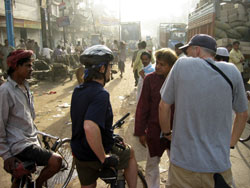
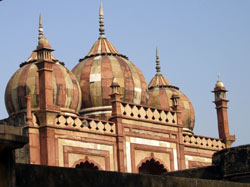
A teacher we're friends with had his brother in town visiting, so on Easter Sunday Mark and I took him on a ride to the Spice Market. On the way we stopped at the Presidential Palace (left), where some kids were rollerblading. Then into the cow-crowded, monkey-riddled streets of Old Delhi. We saw the spice market, the St. Stephen's Church (1867, A41) (above), and the Sunehri Masjid (1721, A86) (top right). |
 |
| March 14, 2004
We went in search of the Ashokan Rock Edict, not knowing much about it except the general neighborhood, that it was on a hill, and that there was a protective cover over it. On the way, we found a tomb that had been (illegally) converted into an Ashram -- a living area for Hindu holy men. Interestingly, it was a Muslim tomb for Langar Khan, a minister to Bahloj Khan in the 15th century. |
 |
 |
| Tomb F93 (1494) They wouldn't let us take photos inside, but it's quite decorated with ceiling fans and fluorescent lights. |
Gateway F94 (1494) It used to be the entrance to the tomb, but now it's a bike storage area and cow shed. |
|
|
|
|
|
| Ashokan Edict F101 (250
BC) Inscription in ancient Brahmi, carved into a hillside by the order of Emporer Ashoka almost 2300 years ago. A metal frame and concrete gazebo have been built to protect the rock. |
The writing was discovered in the 1960s. I'd like to find a translation somewhere. The yellow marks are where people rub gold leaf for good luck. | Mark's taking a photo. Luckily for our pictures, the protective glass has been missing from the metal frame for a long time. Which is bad for the quality of the inscription. The protective concrete covering is the only shade in the area, so kids hang out and sit on the ancient inscriptions to take a break from their cricket games. |




February 29, 2004
|
 |
 |
| Gateway
F460 (1700s) |
Ruins
F463 (1700s) This area has a bunch of mosques, ruins and tombs, but is now used as a public toilet. Which makes it challenging to ride a bike around it. |
Wall Mosque F462 (1700s) |
 |
 |
 |
| Enclosure
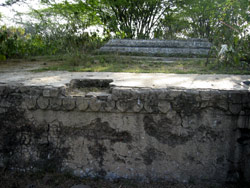
F461 (1700s) It looks like there used to be a pillared dome over this grave, but now all that's left is a grave and a wall. |
Mosque F336 (1400s or
1500s) Old mosque that's mostly closed up and unused. |
Entrance to Mosque F336 (1400s or
1500s) This fancy (but in ruins) gateway is across a busy street from the closed-up mosque on the left. It would have been quite spectacular 500 years ago. |
 |
 |
 |
| Chhaltan-Chihalman F439 (1400s or 1500s) Entrance to the graveyard of the 46 Muslim saints called The Abdals. |
Possibly tomb F440 (1300s) This tomb is being used as someone's house. It might be F440, but it's hard to tell from the photo in the book, since the current residents moved in after the author took his pictures. |
Sohan Burj F442 (late 1400s) Mosque and grand audience hall built by followers of Saint Maqdun Samauddin. |
 |
 Hauz-i-Shamsi F335 (1229 to 1311) This lake was constructed by Iltutmish in 1229, and the red sandstone pavilion was added in 1311.  |
Jahaz Mahal F334 (1400s or 1500s) Former residence of a Muslim holy man. To the lower left is the view as seen from across the lake.  |
Feb 15, 2004
|
 St. James Church (C119, 1836) was the first church built by the British in Delhi. Below: The Hardayal Municipal Public Library (A91) was originally called the Hardinge LIbrary, but renamed after independance. It was originally built in 1916. A new Metro station is being built directly in front of it. |
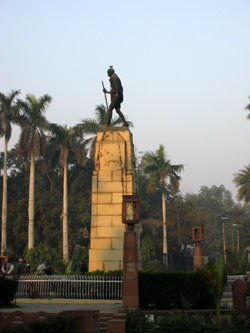 This is a statue of Ghandi in the nearby garden known as Company Bagh (A75), a 17th century garden built by Jahanara Begum, and re-designed by the British in the 19th century. |
|
Feb 8, 2004 We went to an area called Rama Krishna Puram, where there are a whole slew of old Lodi-era tombs and mosques. From the top of the tallest, we got a great view of the stepwell to the left. |
 F14, F18, F17, and F16, a collection of Lodi-era tombs |


 |
 |
||
| The Lodi-era tomb of Bijri Khan, F32 | F33, a Tuglaq-era Tomb just next to the tomb of Bijri Khan | ||
 |
 |
 |
|
| F20, a Lodi-era Wall Mosque | F19, another Lodi-era Tomb | F21, another Lodi-era Wall Mosque | |
Feb 1, 2004 Moradabad Pahari Fort and Shahee Masjid Near Vasant Vihar is a Tuglaq-era fortress (a small one). Inside is are some mosques and tombs. The complex is locked up and inaccessible. Even the encyclopedia of Delhi doesn't have photos of some of the places in here! Well, you can't stop Mark. He climbed the wall and I followed. It's an active mosque and madarsa, and after we had explored a little, the residents and students came out to chat with us. They were quite polite, showed us around, then let us out through the locked gate (without asking us how we entered in the first place!)
This may be the world's only photo of F7, the Lodi-era tomb in Moradabad Pahari! |
|
|
|||
 |
January 25, 2004
Two more tombs -- the 1781 AD tomb of Najaf Khan (D182) (left) And the late Mughal (1700s to 1800s) tomb of an unknown Mughal person, (D197) on the grounds at Nehru stadium. (right.) |
 There are 2 other tombs at the stadium -- one I found in May 04, and one I still haven't found! (note -- I did eventually find it! See April 2005.) There are 2 other tombs at the stadium -- one I found in May 04, and one I still haven't found! (note -- I did eventually find it! See April 2005.) |
|||
Jan 18, 2004 Gary, Mark and Katie and I all went towards the Qutab Minar, to the 1528 AD tomb of Maulana Jamali and his brother Kamali. (I'll never get tired of sharing the road with elephants.)
|
Above, the mosque (F408). Below, the tomb (F409.)
The tomb has some of the most amazing color and tilework in Delhi. Very well preserved!
|
This canopy (F410) was built in 1840 by Sir Thomas Metcalfe, the one-time governer of Delhi. He liked to sit in it and enjoy his view of the tombs and mosques.
Nothing like a nice cup of coffee after a long bike ride! |
|||
Jan 11, 2004 Katie and I went to the delhi stepwell (D45, shown below and on May 2003) then headed into Old Delhi, rode around, dodged buses and cows, and visited a Jain temple. (Shri Digambar Jain Mandir, A209. Photos aren't allowed inside.)
|
A231 - Delhi Gate, built in the 1650s. One of the fourteen gates to the old city, of which only four remain.
|
|
|||
Dec 7, 2003
Above is the entrance to the Zafar Mahal F372, the last Imperial palace built in Delhi. It was built in 1820 by Emperor Bahadur Shah Zafar. Like the Tin Burji, it was locked, so we couldn't see the marble mosque inside, or the 13th century tombs inside.
The tomb above is the final resting place of Khwaja Abdul Aziz Bastami, (F358) a saint of the Suhrawardi sect. One book says that this tomb dates to the Pathan era, which would place it about 15 - 1600 AD. But who knows? |
On the way, we paused at the Tin Burji tomb on Africa Avenue. It was locked, and no one was around to let us in. So it was nearly a year later before I saw the interior.
We also stopped at Chaumachi Khan's tomb, F276. (below)
Potatoes and onions for sale near the Dargah |
The main goal of the day was the Sufi Dargah complex of Khwaja Qutubuddin Bakhtiar Kaki, one of the greatest Chisti Saints of Sufism. He died in 1236, and his tomb is an important pilgrimage site for Sufis. They wouldn't let us in wearing bike shorts, so we hit the clothes shop down the road and each bought a longee, an Indian man's skirt.
|
|||
| Nov 23, 2003
Went back to the Chhote Khan and Bare Khan, but also to these two. |
 |
 |
|||
|
Darya Khan's Tomb D282 |
Tomb of Mubarak Shah Sayyid 1433, D287 This was the first enclosed garden tomb built in Delhi, for a king who ruled from 1421 to 1434. The garden and grounds have been built over, and the city has grown up around the tomb. Now it's sadly quite full of garbage. |
||||
November 9, 2003 Mark took me on a long trip out to Janakpur, far West of Delhi. There's a tower there which is very similar to the Qutab Minar, but less crowded and open to the public, so you can climb to the top. It's also broken off about halfway up, so you can sit at the top and see out all around town.
Janakpur Minar G17, 1650s |
From the top, we saw the city stretching out below. Some local kids followed us up,too. We saw an old hunting lodge in the distance, and headed there after climbing down.
Emperor Shah Jahan's hunting lodge, G18 1650s. |
On the way home we passed an Indian marching band, on their way back from a wedding.
And we saw the Last Train out of Pakistan. A memorial to earlier, friendlier times. |
|||
 |
November 2, 2003
|
 |
|||
| We tried to get inside Humayan's Tomb complex, but the guards wouldn't let us in. Early in the morning, it's open for free to exercise walkers and joggers, but not to bicycles. Later in the morning, tourists are allowed in. So we went around and found another entrance. | Gateway of the Garden of Bu Halima D253 (1560s) One of the earliest Mughal structures in Delhi. |
Sunderwala Burj D265 (1600s) The tomb of an unknown early Mughal. |
|||

Humayan's Tomb D262 (1565)
India Gate D100 (1931) |

Arab Sarai Gate D257 (1561) |

Sabz Burj D247 (1600s) |
|||
| Oct 26, 2003 - On the morning of Diwalli (the Hindu version of Christmas) Mark and I did some serious tomb-hopping. | |||||
 |
 |
 |
|||
| Lal Gumbad, 1397 F129 The tomb of Shaikh Kabir-ud-Din Auliya |
Tomb of Shaikh Salahuddin 1340 F148 Salahuddin was a Sufi saint of the Suhrawardia sect. |
Mughal-era Mahal F136 Built some time from 1500 to the 1700s, it was a residence and school for muslims. |
|||
 |
 |
 |
|||
| Lodi Era Tomb F151 (1456-1526) The tomb of an unknown person. There's a large family living in it now. We hung out with them for a while and they showed us around some of the other tombs in their courtyard.
|
A Lodi-era tomb (F141) seen from between the pillars of Baradari Pavillion (F142 1320-1390) |
Lodi-era Wall Mosque, F131 One of many small mosques located near the Lal Gumbad. |
|||
October 12, 2003 |
 |
 |
|||
Tomb of Raushanara, 1659 C45
|
Dharamasala, 1939 C49 |
Mutiny memorial, one year later. (That's a monkey on the fence.) | |||
September 21, 2003 Stepwells near Qutab Minar The Qutab Minar complex is a series of amazing ancient ruins from 1100 to 1200 AD. This arch (F220) is from 1191 and the tower (F219) on the right is from 1202. Our main goal on this ride was not the Qutab complex, but two stepwells nearby.
|
   |
|
|||
|
Katie and I did the ride to the spice market again on Sept 14, 2003. This time, we stopped at Firoz Shah Kotla (1354, D62) on the way back. It's a large complex of ruins.
[above] The Friday Mosque of Firozabad [left] The Pyramidal Structure (1354, D63) and Ashokan Pillar (300 BC, D64) This is another one of those ancient stone monoliths that Feroz Shah Tuglak carried to Delhi in the 14th Century. He built this huge pyramid to put it on. |
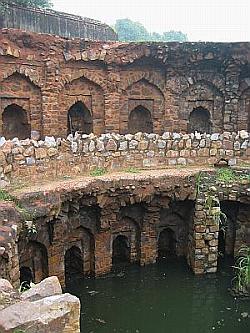 Circular Baoli (Stepwell) 1354, D66 It keeps going down, level after level, into the water. People used to walk down the stairs to fill their buckets. When you have a bunch of thirsty people, that method works better than the narrow European bucket on a rope. |
|||
 |
 |
||||
| Aug 24, 2003 Climbing the wall of the Qudsia Garden Gateway, 1748 C85 |
Shahi Mosque of Qudsia Begum, 1748 C86 Qudsia Begum was the wife of Emperor Muhammad Shah. |
||||
 |
August 17, 2003
|
 |
|||
|
August 10, 2003 The Tomb of Bahlol Lodi (center column) F179, AD 1488 is a terribly neglected tomb, considering that the guy buried in it is the founder of the Lodi dynasty. |
 |
 |
|||
| In the right-hand-column are two Lodi-era tombs -- F170 and F175, built somewhere in the last 1400s to early 1500s. The tombs are in a Sufi tomb complex surrounding the 14th C tomb of Roshan Chiragh Delhi, a famous Sufi saint. His presence is the reason Bahlol and others wanted to be buried here. |  |
 |
|||


